Is it okay to carry hope? Discover how Seneca’s wisdom describes fear and hope as one and the same.
Is it okay for us to hold on to hope? This question has been bothering me for the past three years, ever since I read this iconic line in Seneca’s Letters, “Fear keeps pace with hope. The two of them march in unison like a prisoner and the escort he is handcuffed to.” And indeed, this makes sense. In school, we hope to earn good grades so we can get into post-secondary education and beyond. Then, all of a sudden, we end up with a fear of failure. Well, then, is it okay for us to hold on to hope?
Indeed, it has to be… We have seen people lay down their lives for hope, time and time again, throughout recent history (WWI to today), with the dream that one day there will be global peace.
Would the soldiers of World War I still lay down their lives if they saw the state of the world today?
I really don’t know. I am fortunate enough not to have experienced the horrors of warfare of the past or of specific regions in the present. And I’m sure I am not the only one who hopes to secure a well-paying job, financial stability, and a home. Then this is still hope. It’s certainly not in the same ‘global state of humanity’ that soldiers in the past have faced, yet isn’t that the hope?
Well then, what about hope in the form of obsessive crushes? The ‘admirer’ definitely carries a lot of hope within them. However, would we consider this to be on the same level as, “I will die for my country for the slightest chance for global peace?”- probably not.
Well, whether it’s form, hope always drags fear right behind it- just like Seneca describes. Alongside this, comes an ‘outlook’ of the world (hopeful vs fearful scenario) which can look as cartoonishly binary as this photo:
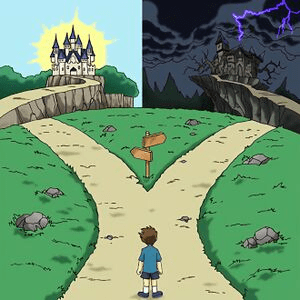
Where, if we take in the example of the obsessive lover, we may accidentally operate in the ‘be all and end all’ of: Hope; we get married and live happily ever after, OR fear; they reject me and no one ever loves me.
Both cases are equally absurd and share a common theme of disregarding the present. Which, firstly, closes our eyes to clues in the present (such as those signposts) which may help guide our decisions. And secondly, forces us to live in the future and choose between two unrealistic binaries.
Seneca describes this process as a form of projection where “thoughts are [sent] far ahead of us.” Which, as those of us who tend to daydream, feel. Now, why do we even hope in the first place, and how does fear work its way into hope?
Purpose of Projection
The process of hoping and fearing, described as ‘Projection’ by Seneca, can be thought of as serving two primary purposes. As both a motivator, and a soother.
Firstly, projection highlights the gap between the present and our goal. Which can both motivate us and fill us with hope as we begin to think about ‘what could bes’ but can also fill us with fear, ‘what if I get stuck?’ Interestingly enough, this fear reaction, in healthy doses, is our minds own ‘motivational trick’, which forces us into action.
For example, imagine a high school student applying to post-secondary schools. They view applications as almost an ‘be-all and end-all’ of their career, which both provides the necessary motivation and hope to execute essential action. While also filling them with a sense of anxious fear about the uncertain future.
It’s that uncertainty which projection works to soothe. Projection’s second purpose is to ‘mentally shape’ uncertainty into something more concrete. As we have explored in previous blogs, our greatest fear is the unknown. When we turn to the future, many of us are fearful of what could happen. No more is this evident in today’s culture, where, quite literally, anything can happen! We practically live in the ‘uncertain times.’
For example, take positive daydreaming (future job) that happens when we are stressed or bored. This is projection in play, literally replacing ‘fearful visions’ of the future with more ‘hopeful visions’ of the future. Yet, there’s a problem with this; this is an emotion-based coping mechanism. We are replacing one emotion (fear) with another (hope). By doing so, we are oscillating between two emotional extremes, which is detrimental to finding peace in the middle of the spectrum. To do so, we must begin to adapt ourselves to the present.
Adaptation
“The march of unison, of hope and fear; much like a prisoner and their escort does not surprise me. Both are due to a projection of our thoughts far ahead of us, instead of adapting ourselves to the present.”
Both fear and hope steal us away from the present and into dreams of the future. This handicaps our ability to live in and work with the present. Which ironically prevents us from reaching the hopeful scenario. When we focus too much on the future, we miss all the opportunities within the present.
This very dilemma is what makes us human. One of the most striking differences between humans and other animals is our capacity for creativity. This is both what enables us to create tools and our own personal hells. The last sentence of Seneca’s quote reminds me of this,
“Wild animals run from dangers they actually see; once safe, they worry no more. We, however, are tormented alike by what is past, and what is to come.”
Our ability to carry both hope and fear is what makes us human. It drives us to dream of better tomorrows, yet can trap us in unrealistic futures. Our goal then, is not to abandon the blessing that is hope, but to learn how to properly carry it, without being stolen from the present. In part 2, we will explore how to carry hope, while staying grounded in the present. For if we get caught up in hope and lose our ground in the present, the doorway we are seeking may open, then close, without us ever noticing.
Make a one-time donation
Make a monthly donation
Make a yearly donation
Choose an amount
Or enter a custom amount
Your contribution is appreciated.
Your contribution is appreciated.
Your contribution is appreciated.
DonateDonate monthlyDonate yearly
Leave a comment