In the last blog, we discussed Dr Kanojia’s framework to limerence, which compiled aspects of ADHD (fantasy), OCD (obsession) and attachment wounds (the big boss) into a ‘three pronged approach’ to understanding the etiology of limerence. In this blog, I want to expand on his approach as well as discuss methods I use to deal with the several aspects of limerence.
Disclaimer: I have no certifications in the mental health or medical realm. This blog is intended to highlight my experience with limerence, what works for me, and to inspire others to pursue insight practices. If you are struggling or even wish to pursue insight practices, then contact a licensed mental health professional.
Here is his video
The Fantasy Perspective
Dr Kanojia highlighted that the creative and fantastical thinking of those living with limerence may have their roots in slight ADHD tendencies. Of which, I can see parallels within my own life; I have always been able to get lost in daydreams, unfortunately, this ability fed into my limerence and drove the intrusive fantasies to a whole new level.
These fantasies used to be so bad that I would get almost ‘paralyzed’ by them. I would get so caught up by the mental version of the crush that I would miss the real interactions that tell me who she actually is. And most importantly, if I actually like her, and not just the limerence talking.
Mindfulness
So I decided to do something about this. Over the course of the past year I began to work on noticing when I slip into fantasy. This is hard, as fantasizing is something I do automatically that sometimes I don’t even realize I’m in one until minutes have passed. But that’s just a part of my journey, I’m getting better at it!
These “automatic thoughts” are challenging to deal with, much like how you don’t realize you are breathing until you’ve read this sentence (sorry). To help bring awareness to these automatic thoughts, I started a meditative and mindfulness practice. It’s nothing too special, just fifteen minutes of counting in/out breaths a day and acknowledging the temporary nature of thoughts, feelings, and life. Yet, I’ve found this simple practice helps me both ride fantasy out and break through it.
A friend once described mindfulness practice as noticing leaves flowing down a river. Although fantasy is more appropriately described as a log damming up the whole thing. The analogy still applies; see the fantasy with non-judgmental awareness. Just. Simple. Awareness.
Once we notice the fantasy and detach our attention from ourselves, I then want us to focus on the present moment and ground ourselves in it. We can do this by noticing and observing the sensations that come up in the present moment, such as through the 5-4-2-3-1 method.
This allows us two things. First, we take power away from the fantasy by directing our attention away from it. And second, we train ourselves to focus on the present moment when distracting thoughts appear, and slowly unlearn fantasizing in the first place.
Quick Interlude into Cognitive Science’s Dynamical Systems Theory
What a mouthful, eh? In one of my Cognitive Science (the interdisciplinary study of the brain) classes, we started to discuss the application of dynamical systems theory (DST) in understanding how cognition works. I will spare you the heavy details- we discussed a fascinating theory behind how psychopathology (umbrella term for mental disorders, etc) is correlated to specific ‘attractor basins’ within our brain’s neural network. Please see the image below:
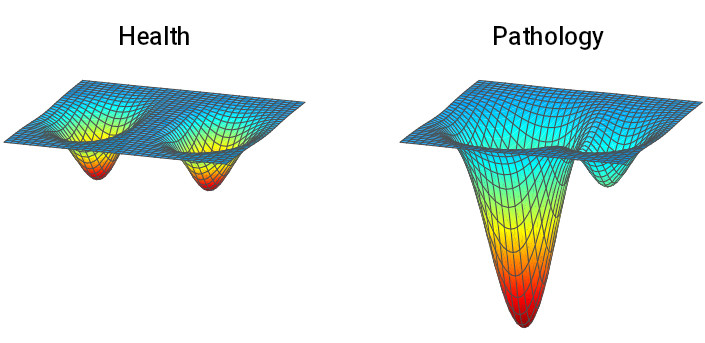
What is fascinating is how deep the attractor basin is in psychopathology compared to what is expected of a normal brain state. Furthermore, the deeper the attractor basin, the harder it is to get out of. Well then, what do we do with this information? It helps explain how specific maladaptive thoughts have so much power; they are literal sinkholes in our cognitive processes. Additionally, the more energy we expend on maladaptive thoughts (playing into fantasy), the deeper the hole will become. So go and redirect your attention to the present!
https://structures.uni-heidelberg.de/blog/posts/2023_10_koppe/index.php
Fantastic Conclusion
All in all, the person living with limerence’s marked capacity to fantasize may be linked to slight (more than average) ADHD tendencies and negative feedback loops. To combat this, I have found that cultivating awareness through meditation is effective as it allows us to ‘stand ground’ during rushes of fantastical thought and return to the present.
The Obsessive Perspective
In his video on limerence, Dr Kanojia explained how slight OCD traits may be responsible for the obsessions behind limerence; my own lived experience backs this up. To help combat my obsessions and compulsions, I’ve drawn a lot from Exposure and Response Prevention (ERP) Therapy, which is the gold standard therapy for treating OCD.
There is one caveat, though, we are not dealing directly with a diagnosis of OCD, just manifestations of OCD-like symptoms, so keep that in mind. The goal of ERP therapy is quite simple: prevent feeding into compulsions (in our case, intrusive thoughts/fantasy), which, over time, teaches us how to cope with uncomfortable situations (in the presence of obsession) without the need for compulsions.
In our case, this is spending time around the person we are limerent for while attempting to control our anxiety and limerent thoughts (both before and after). Similar to the mindfulness techniques we explored in the last part, practicing ERP therapy will eventually build stress tolerance to the stimulus, in addition to accepting any distress. Most importantly, without our compulsions, this sets up space for us to use a healthy coping mechanism during distress.
A method I was taught, which I try to use during ‘limerent episodes’ (when I get so strong, I get thrown off), is the RAIN technique. It is a simple mindfulness method, but rather powerful. On top of this, I also use Viktor Frankl’s dereflection and rarely paradoxical intention.
RAIN Technique
Recognize: Recognize that you are experiencing limerence. How does it feel both mentally and physically?
Allow: Allow these feelings of limerence in your body. Acknowledge it, and accept it. Be kind and compassionate to yourself. Remember that limerence is only temporary; it will pass in due time.
Investigate: With loving kindness, investigate the feeling of limerence in your body and how it arises. Observe and pay attention to the type of thoughts that arise. Do so in a non-judgmental and curious way.
Nurture: Remind yourself that this feeling will pass, do what you can to soothe and calm yourself; step away if you have to. Nurture the inner child (We will dive into this in the Attachment wound section).
The RAIN technique, while simple, is highly effective at soothing limerence. I’ve used it here and there, and what I found is that I can gain a lot of insight into how limerence affects my body and my thoughts. At the same time, I am providing space to nurture and ground myself in the present. I would recommend it.
Logotherapy Techniques
Here I am talking about Logotherapy again. Many of Frankl’s techniques have great applications within anxious emotion management, so here are some fun applications:
Paradoxical intention: This one is fun; you basically do the exact opposite of what you are trying to control in your body (I would not recommend doing this for mental phenomena). For myself, I tend to shake a lot during limerent episodes, which I worry others can see. So I’ve tried this technique before. First, I acknowledge that I am shaking, then I reframe it: “This shaking is evidence that I care about x.” Lastly, I try to (if it is safe and appropriate to do so) shake and tremble more to counteract the limerence. From what I recall, it wasn’t the most effective for me, but still fun to do.
Dereflection: This is one of my personal favourite techniques for dealing with the obsessive side of limerence. Dereflection works by redirecting our attention away from anxious thought loops and onto other things, such as meaning (reframing, shaking into care), a different task (being present with it), and some of our values. A quick note on the values, an impactful example of this was when I was stuck in a particularly anxious episode of analysis paralysis (where I could not make a decision) for a good few hours. To break free of it, I thought, “What would a person with my cultivated set of values do?” Once I was done brainstorming, I followed through on those actions and ended up breaking the paralysis!
Wrapping Up Obsessive Compulsive
The techniques we discussed today for dealing with the obsessive side include: The RAIN technique, paradoxical intention, and dereflection. In a broad sense, these techniques involve acknowledging how one feels and shifting attention away from anxious thoughts.
The Attachment Wound
As I hinted at earlier, attachment wounds are the ‘boss’ or more accurately, the ‘source’ behind limerence as a whole. To give us a quick refresher, humans broadly fall into a spectrum of attachment styles, which includes: Avoidant, Anxious, Secure, and Disorganized. As the name suggests, we are most interested in the relationship between Anxious Attachment and limerence.
What is Anxious Attachment?
Anxious Attachment styles, like all attachment styles, develop through a child’s early interactions with other humans (often their caregivers). What makes this period of our life so ‘delicate’ is the fact that our caregivers teach us what to expect from other human beings.
Anxious Attachment style stems from several potential parenting styles: Inconsistent caregiving (whereby the child’s needs are sometimes met and sometimes not met). Emotional hunger: Where the caregiver uses the child to satisfy their own emotional needs. And lastly, anxious parenting, where the parent’s anxious behaviours are learnt by the child (not through genetics).
These experiences ultimately manifest in how we form bonds throughout our lives, particularly our romantic bonds. Oftentimes, the person living with anxious attachment experiences fear of rejection, an increased need for reassurance, doubt, the need to rush things, fantasizing, and a fear of uncertainty. On top of this, anxious attachment comes with obsessive features as well, particularly aligned with the notion of “My life is incomplete without a partner.” Interestingly, this is due to a negative view of the self combined with a positive view of others (world).
We can already see some parallels between anxious attachment and limerence, such as some obsessive features and fantasizing. In this next section, I want to dive a little deeper into attachment wounds and treat limerence as a trauma response/maladaptive coping mechanism.
Limerence as a trauma response
If there is one thing our minds excel at, it is surviving under all circumstances. Due to neuroplasticity, our brains can do incredible things, such as recover after traumatic brain injury. Yet, with this profound ability (to heal) comes the capacity to form maladaptations; limerence is one such example.
I view limerence as a projection of our ‘caregiver’ needs onto other people. The one living with limerence sees their mother (or caregiver) in every girl they meet because that is what they are grieving.
Moreover, limerence or fantasy is a wall our brain has put up to protect us from the intense undercurrents of caregiver grief that lie underneath. Furthermore, our denial transforms this wall into the horizon, trapping us in fantasy.
If we wish to move beyond limerence, we must begin to dig up the pure grief that lies underneath. Which is no easy task, for this pain has been marinating for years. But now, you are capable and ready to face it. Assuming you are on the same path as I am, here are some of my tips to dig into the grief that feeds limerence. Although I am still doing this work… God knows how long it’ll take… So this is nowhere near a complete or fleshed-out list… And of course, this is subjective to me, so it may not perfectly fit your life.
This is best done with a therapist.
Narrative: Construct a narrative of your life, write down memories, facts, and significant events from all seasons of your life, up until today.
Identify: Negative experiences, especially those that happen early in life.
Trace: Begin to trace how those negative experiences impacted your life. (The consequence that led to xyz)
Patterns: Seek out patterns in your life that stand out.
Core wounds: Identify your deep insecurities.
Understand: Act to understand your life and extend compassion to your inner child.
Identify triggers: Learn to recognize what triggers and ‘retraumatize’ your inner child, and start protecting your energy by avoiding/being mindful of those sources.
Fulfill your needs: Identify what your younger self needs and act to fulfill it yourself. (Note: this does not mean a staunchly independent position where you don’t let anyone fill your needs. Instead, you meet your inner child’s needs yourself, then bring your adult needs to those around you.
Work towards peace: Healing is a lifelong project, so continue, every day, to slowly but surely make your way towards the inner peace and tranquility you know you can provide.
Attachment Wound Conclusion
Out of all of the sections in this blog, the attachment wound section is the hardest one to write, due to the highly subjective nature of trauma. The main thing that I want to get across to you is that, firstly, limerence is a trauma response, and second, that healing from limerence is possible. To build on this, it requires insight, self-compassion, and resiliency, which a therapist best facilitates. For this is no easy task, you are bringing your most traumatic and impactful experiences to light, after years of growing in the dark. Yet, remember, the ability to free yourself from yourself is worth its weight in gold.
Overall Conclusion
As of writing, this blog is nearly seven pages long and is one of the most open, honest, and extensive blogs I’ve ever written, representing the type of insight I want to give back to the world. I hope it helps, even a little bit. This blog contains a good year’s worth of my journey with managing limerence and countless tidbits from the days I spent journaling over the summer.
We have highlighted limerence as influenced by slight ADHD and OCD tendencies, and we have discussed various techniques and practices to manage such dimensions. Most importantly, we have discussed limerence as primarily caused by a trauma response, where we have highlighted both the possibility of healing and a direction for one to do so.
I hope this blog helps you wherever you are. Healing is possible; it takes time and courage.
Disclaimer: I am not certified as a mental health professional, this is merely about my own experience living with limerence.
Make a one-time donation
Make a monthly donation
Make a yearly donation
Choose an amount
Or enter a custom amount
Your contribution is appreciated.
Your contribution is appreciated.
Your contribution is appreciated.
DonateDonate monthlyDonate yearly
Leave a comment